
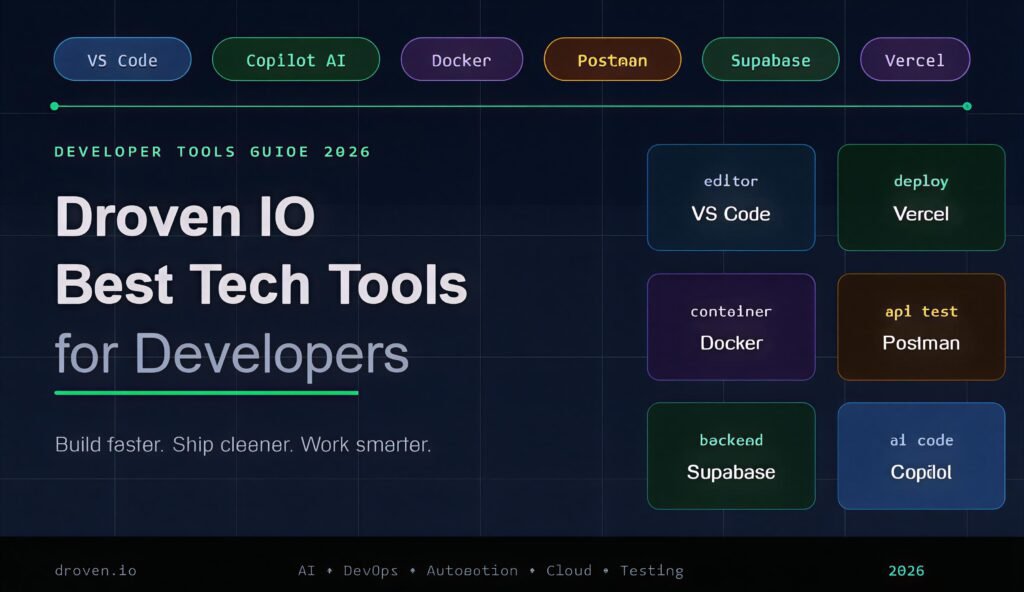

Droven IO Best Tech Tools for Developers The way developers build software has changed fast, and the tools you pick today directly affect how well you ship tomorrow. Most developers waste hours jumping between apps that don’t connect, repeating tasks that could easily be automated. The droven io best tech tools for developers concept focuses on purposeful tool selection rather than collecting every option on the market. Instead of chasing every new framework, the focus stays on what genuinely reduces friction and helps you write better software. The right tools don’t just make you faster — they make you a fundamentally better developer.
What Droven IO Best Tech Tools for Developers Really Means
Before diving into specific tools, it helps to understand what this framework is actually pointing at — because it’s not about installing more software. It’s about building an ecosystem where your editor, testing tools, deployment pipeline, and collaboration software all work together smoothly. Most developer setups are a mess — tools chosen at different times, for different projects, with no thought about how they connect. The droven io best tech tools for developers approach pushes you to treat your full development lifecycle as one system. When you think that way, you stop asking “what tool should I use?” and start asking “how does this fit into how I already work?”
The Problem With Tool Overload
Almost every developer has experienced tool fatigue — too many options, too many subscriptions, too many tabs open just to get through a day. Tool overload doesn’t just waste money; it wastes mental energy and slows down your whole team. The droven io best tech tools for developers perspective helps you cut the noise and focus on tools that genuinely earn their place. The best setups are minimal — a few deeply understood tools used consistently beats a sprawling collection of half-configured software. Once you apply this thinking, you’ll find yourself removing tools just as often as you add them.
Visual Studio Code — The Editor That Does It All
Visual Studio Code has earned its place at the center of the modern developer toolkit by consistently solving real problems developers face every day. It starts fast, handles large codebases well, and its extension marketplace lets you shape it to match any language or workflow. The droven io best tech tools for developers stack highlights VS Code because it acts as a hub — Git integration, debugging, and terminal access all live in one window. Its live share feature transforms remote collaboration, letting multiple developers work inside the same session in real time. VS Code grows with you — beginners stay productive with defaults while experienced developers customize it deeply.
GitHub Copilot and the AI Coding Shift
GitHub Copilot is more than an autocomplete upgrade — it represents a real shift in how developers write code day to day. It reads the code around your cursor, your comments, your function names, and generates suggestions that feel like a knowledgeable colleague helping out. Developers using it consistently spend far less time on boilerplate and repetitive patterns, freeing up focus for harder problems. The trick is not accepting every suggestion blindly but using it as a fast first draft that you then review and improve. What Copilot really does is move your attention away from syntax details and toward architecture and logic decisions that actually matter.
Docker and Why Environment Consistency Changes Everything
Docker solved one of the most frustrating problems in software development — the “works on my machine” situation that has derailed countless projects. By packaging your application with all its dependencies into a container, Docker ensures what runs locally is identical to what runs in production. The droven io best tech tools for developers approach treats Docker as non-negotiable for serious software work because it eliminates an entire class of hard-to-diagnose bugs. Beyond consistency, Docker makes onboarding new developers dramatically easier — spinning up a local environment goes from a half-day ordeal to a single command. Teams that adopt Docker properly find their deployments become calmer, more predictable, and far less stressful.

Postman and the Importance of Proper API Testing
Modern software is almost entirely built on APIs, yet many developers treat API testing as an afterthought rather than a core workflow step. Postman fills that gap by letting you build, test, document, and share API requests in an organized, repeatable way. The droven io best tech tools for developers stack emphasizes Postman because if your APIs don’t work correctly, nothing else in your application works correctly either. Its environment variables feature lets you switch between development, staging, and production configurations instantly without rewriting requests. As your project grows, having well-maintained Postman collections becomes one of those invisible productivity multipliers you only appreciate when you join a team without them.
Supabase as a Backend Platform Worth Knowing
Supabase has become one of the most exciting backend platforms available, especially for teams that want real power without building an entire infrastructure from scratch. It gives you a Postgres database, authentication, real-time subscriptions, and file storage — all in one platform with a clean dashboard. The droven io best tech tools for developers framework highlights Supabase because it dramatically compresses the time between idea and working product. You can go from zero to a fully functional backend in hours rather than days, which matters enormously when you’re moving fast on a new project. It’s open source, which means you’re never locked into a vendor and can self-host when your needs grow.
Prisma and Clean Database Management
Prisma changes how developers interact with databases by replacing raw SQL queries with a type-safe, readable API that works beautifully with modern JavaScript and TypeScript projects. It generates a client based on your schema, which means your IDE can autocomplete database queries and catch errors before you even run your code. The droven io best tech tools for developers approach values Prisma because it reduces an entire category of database bugs that typically only show up at runtime. Migrations become manageable and trackable, which is a genuine relief on any project that lives long enough to need database changes. Working with Prisma feels less like wrestling with a database and more like working with well-structured application code.
Vercel and the Modern Deployment Experience
Vercel made frontend deployment feel almost effortless, and that simplicity has real consequences for how fast teams can actually ship working software. You connect your repository, push your code, and Vercel handles the build, the CDN distribution, and the preview deployment — automatically, on every pull request. The droven io best tech tools for developers philosophy values Vercel because it removes infrastructure complexity from the equation and lets developers stay focused on building. Preview deployments in particular change how teams do code review — instead of reviewing code in isolation, reviewers can click a live link and actually interact with the changes. For teams building with Next.js, Vercel is a natural fit that makes the entire development-to-production loop faster and more reliable.
Playwright for Testing That Actually Works in the Real World
Playwright has quickly become the preferred choice for end-to-end testing because it handles the things that older testing tools consistently struggled with — multiple browsers, modern JavaScript-heavy apps, and flaky network conditions. It lets you write tests that simulate real user interactions: clicking buttons, filling forms, navigating between pages, and verifying that the result is what you actually expected. The droven io best tech tools for developers stack includes Playwright because skipping end-to-end testing is one of the most common and most expensive mistakes development teams make. Good tests catch regressions before they reach users, which means fewer emergency fixes at midnight and fewer apology emails to customers. Playwright’s auto-wait behavior also eliminates most of the timing issues that made older testing tools feel unreliable and frustrating to maintain.
Jira and Keeping Teams Aligned Without the Chaos
Once a team grows past a handful of people, keeping everyone aligned on what’s being built, what’s being fixed, and what’s coming next becomes genuinely difficult without proper project management tooling. Jira gives teams a shared view of the work — who owns what, what stage it’s in, and what’s blocking progress — so nothing important falls through the cracks. The droven io best tech tools for developers approach includes Jira not because it’s glamorous software but because miscommunication and unclear priorities kill more projects than bad code ever does. Sprints, backlogs, and bug tracking all live in one place, which reduces the number of Slack messages asking “hey, what’s the status on that thing?” It’s not a perfect tool, but used with discipline it creates the kind of shared clarity that lets engineering teams actually move fast.
CI/CD Pipelines and Why Automation Is Not Optional Anymore
Continuous integration and continuous deployment pipelines have moved from nice-to-have to genuinely essential for any team that ships software regularly and cares about quality. A good CI/CD setup automatically runs your tests, checks your code quality, and deploys to staging or production every time code is merged — without anyone having to remember to do it manually. The droven io best tech tools for developers framework highlights CI/CD because manual deployment processes are one of the biggest sources of avoidable errors in software teams. Tools like GitHub Actions make setting up these pipelines accessible even for smaller teams without dedicated DevOps engineers on staff. When your pipeline is working well, shipping new features feels routine rather than stressful, which changes the entire culture of how a team approaches releases.
Figma and Why Developers Who Understand Design Ship Better Products
Figma sits at the intersection of design and development, and developers who learn to read and work with Figma files ship better products because they understand the intention behind what they’re building. Instead of guessing what a component should look like or pinging the designer every five minutes, you can open the Figma file and inspect spacing, colors, fonts, and component states directly. The droven io best tech tools for developers ecosystem includes Figma because the friction between design and development is one of the most common causes of slow releases and last-minute rework. Dev mode in Figma makes this even more useful by generating CSS properties, spacing values, and asset exports directly from design components. Developers who get comfortable in Figma become much better collaborators, and that collaboration directly translates into products that look and feel exactly as intended.
Notion and Keeping Your Technical Knowledge Actually Organized
Technical knowledge has almost no value if it lives only in someone’s head or gets buried in a Slack thread from three months ago, and that’s the problem Notion helps solve for development teams. It works as a wiki, a project doc, a meeting notes hub, and a lightweight database all at once, which means your architecture decisions, onboarding guides, and API references can actually live somewhere findable. The droven io best tech tools for developers approach values Notion because the cost of undocumented systems compounds fast as a team grows — new developers get confused, old decisions get repeated, and institutional knowledge walks out the door when people leave. Unlike traditional wikis that feel stiff and outdated, Notion is flexible enough that teams actually use it and keep it updated. Good documentation written in Notion is one of those investments that looks unnecessary until the day it saves someone hours of confusion.
Slack and the Reality of Developer Communication at Scale
Communication tools matter more than most developers want to admit, and Slack has become the de facto standard for how development teams talk to each other during the workday. The droven io best tech tools for developers stack includes Slack not just because it’s popular but because it integrates with almost every other tool in the ecosystem — GitHub notifications, deployment alerts, error monitoring, and CI results can all flow into Slack channels automatically. The real power isn’t the messaging itself; it’s building a culture of async communication where context is written down rather than held in someone’s head and expected to be remembered. Good Slack hygiene — clear channel naming, threading conversations, pinning important links — makes teams dramatically more effective, especially when working across time zones. Without intentional communication practices, even great tools like Slack become a source of noise rather than clarity.
Sentry and Catching Errors Before Your Users Tell You About Them
Sentry monitors your application in production and alerts you the moment something breaks, which means you find out about errors from your dashboard rather than from angry users on social media. It captures the full context of every error — the stack trace, the user’s browser, the actions they took before the crash — which makes debugging production issues dramatically faster than staring at raw logs. The droven io best tech tools for developers framework values Sentry because production bugs are inevitable, but being caught off guard by them is avoidable with the right monitoring in place. You can set up alert thresholds so you’re not buried in notifications for minor issues, while still being immediately informed about anything critical. Over time, Sentry also gives you a picture of your application’s overall health and shows you which parts of your codebase generate the most problems.

TablePlus and Working With Databases Like a Professional
TablePlus is one of those tools that developers discover and immediately wonder how they worked without it — it’s a clean, fast database GUI that works across PostgreSQL, MySQL, SQLite, Redis, and more. Instead of writing raw queries just to peek at your data or verify that a migration ran correctly, you get a visual interface that shows you exactly what’s in your database and lets you edit it safely. The droven io best tech tools for developers ecosystem includes TablePlus because working directly with databases is a daily reality for most backend developers, and doing it well requires more than a terminal window. Its tab-based interface lets you keep multiple database connections open simultaneously, which is essential when you’re comparing data across development, staging, and production. The connection security features also ensure you’re not accidentally running a destructive query against your production database when you meant to target staging.
The Mindset Behind Choosing Tools That Actually Last
Beyond any specific tool, the droven io best tech tools for developers philosophy is really about developing the judgment to choose tools that will serve you well over time rather than just solving today’s problem in the most obvious way. Good tools have strong communities, clear documentation, active maintenance, and a track record of stability — and those qualities matter more than whatever features sound impressive in a demo. Every tool you add to your stack carries a maintenance cost, a learning curve for new team members, and a dependency you’ll have to manage as your project evolves. The best developers are ruthlessly selective about what they let into their workflow, and they revisit those decisions regularly rather than assuming that last year’s choices are still the best ones available. Building software is hard enough without tools that fight you — so the standard should always be that every tool in your setup earns its place by making your work meaningfully easier.
How to Start Applying the Droven IO Best Tech Tools for Developers Approach Today
The most practical way to start is not to overhaul your entire setup at once but to look at your workflow and identify the single biggest source of friction or wasted time in your daily work. If deployments stress you out, start with Docker and Vercel. If you’re catching bugs too late, start with Playwright and Sentry. If your team communication is chaotic, look at how you’re using Slack and Notion before adding anything new. The droven io best tech tools for developers approach works best when it’s applied gradually and intentionally, not as a wholesale replacement of everything you currently use. Give each new tool enough time to become familiar before judging whether it’s working — most tools only show their real value after you’ve used them long enough to build proper habits around them.
Conclusion
The tools you start with won’t necessarily be the same ones you use two years from now, and that’s completely fine — the goal is to build a stack that scales with your projects and your team rather than one that looks impressive on paper. Start with the essentials: a great editor, version control, containerization, and a testing strategy, and then add tools as genuine needs emerge rather than in anticipation of problems you might never have. The droven io best tech tools for developers philosophy is ultimately about continuous improvement — regularly asking whether your current setup is still serving you, being willing to change what isn’t working, and staying curious about tools that might solve problems you’ve quietly accepted as inevitable. The developers who build the best things aren’t usually the ones with the most tools; they’re the ones who know their tools deeply and use them with intention. Start simple, stay disciplined, and let your stack evolve as your work demands it.
FAQs
What is droven io best tech tools for developers?
It refers to a curated set of modern tools — like VS Code, GitHub Copilot, Docker, Postman, and Vercel.
Do I need all these tools at once?
No. Start with the tools that address your biggest pain points right now and add others gradually as real needs come up.
Are these tools suitable for beginner developers?
Most of them are beginner-friendly, especially VS Code, Postman, and Supabase.
How do I know if a tool is actually worth adding to my workflow
? A good rule — if a tool saves you more time than it takes to learn and maintain, it earns its place.
Is the droven io approach only for solo developers or does it work for teams?
It works for both. Solo developers benefit from the productivity gains, while teams benefit even more because shared.
Read also: BN6925167C What Samsung TV Owner Needs to Know About