
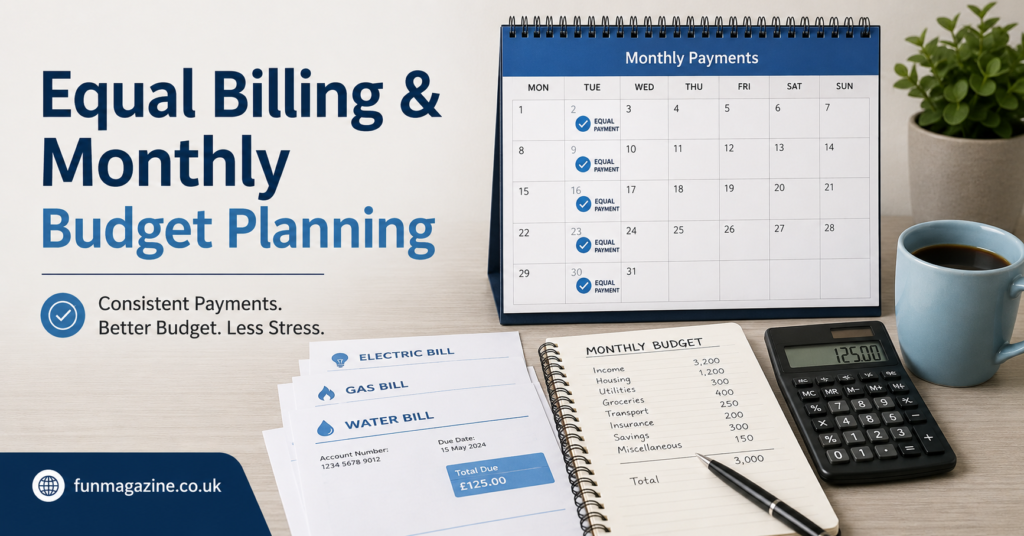

What is equal billing and how can it help you when creating your monthly budget? It’s a payment system where your utility provider calculates your average yearly usage and divides it into equal monthly payments so you pay the same amount every month instead of facing seasonal ups and downs.
Instead of dealing with high bills in extreme weather months and lower ones during mild seasons, you get a fixed, predictable amount. This doesn’t change your total yearly cost—it simply spreads it out evenly.
At the end of the billing cycle, your provider compares your estimated usage with your actual consumption. If you used more energy than expected, you may need to pay a small difference. If you used less, you may receive a credit or adjustment.
In simple terms, it turns a fluctuating expense into something steady you can plan around.
How Equal Billing Works
Equal billing follows a straightforward process that relies on averaging your usage.
Here’s how it typically works:
- The utility company reviews your past usage history (usually 6–12 months).
- They estimate your total yearly cost.
- That total is divided into 12 equal payments.
- You pay the same amount every month.
- At the end of the year, your account is reviewed and adjusted.
Example:
- Estimated yearly utility cost: $1,200
- Monthly equal billing payment: $100
Even if your actual usage varies monthly, your payment remains the same.
This simple structure is what makes budgeting easier and more predictable.
Key Features and Main Benefits
Equal billing offers more than just convenience—it improves financial planning.
1. Predictable monthly expenses
You always know what your bill will be, which makes budgeting more accurate.
2. Reduced seasonal pressure
No more worrying about high winter heating bills or summer cooling spikes.
3. Easier financial planning
When one major expense is stable, it’s easier to allocate money elsewhere.
4. Better cash flow management
Your monthly expenses stay balanced instead of fluctuating heavily.
5. Less financial stress
No surprise bills means fewer disruptions to your monthly plan.
Advantages and Disadvantages
Like any financial tool, equal billing has both strengths and limitations.
Advantages
- Stable monthly payments
- Easier budgeting and planning
- Reduced bill shock
- Helpful for fixed-income households
- Encourages financial discipline
Disadvantages
- Year-end adjustment may result in extra payment
- Based on estimates, not exact usage
- Can be adjusted mid-year by providers
- Doesn’t reduce total utility cost
The key is understanding that it’s about stability, not savings.
Practical Uses in Real Life
Equal billing becomes especially useful in everyday financial planning.
Salaried workers
Fixed monthly income pairs well with fixed monthly expenses.
Families
Households with fluctuating energy use benefit from consistent payments.
Students and renters
Helps maintain control when managing tight budgets.
Freelancers
Even when income varies, stable bills reduce financial uncertainty.
Important Insights You Should Know
There are a few things people often misunderstand about equal billing.
It doesn’t lower your bill
You still pay the same total amount over the year.
It relies on estimates
Your usage history determines your monthly payment.
It adjusts over time
If your usage changes, your monthly amount may also change.
It’s not universal
Not every utility provider offers it automatically.
Equal Billing vs Regular Billing
Here’s a simple comparison:
| Feature | Regular Billing | Equal Billing |
|---|---|---|
| Monthly payment | Varies | Fixed |
| Budget predictability | Low | High |
| Seasonal spikes | Yes | No |
| Planning ease | Difficult | Simple |
Regular billing fluctuates. Equal billing stabilizes.
Common Mistakes People Make
Many users misunderstand how equal billing works.
1. Thinking it reduces cost
It only spreads payments, it doesn’t lower them.
2. Ignoring annual adjustments
End-of-year settlement often surprises people.
3. Not tracking usage
Even with fixed payments, monitoring usage is still important.
4. Assuming it never changes
Utility providers can adjust your monthly amount if needed.
Expert Tips and Best Practices
If you want to get the most out of equal billing, keep these in mind:
Monitor your consumption
Small changes in habits can significantly affect yearly costs.
Review your annual statement
This helps you understand how accurate your billing plan is.
Use a budgeting system
Include equal billing as a fixed expense in your monthly budget.
Keep a small buffer
Prepare for potential year-end adjustments.
Conclusion
Equal billing is less about changing what you pay and more about changing how you pay it. By turning unpredictable utility costs into a stable monthly amount, it removes one of the biggest variables in personal budgeting.
When your bills become predictable, your entire financial plan becomes easier to manage. You stop reacting to surprises and start planning with clarity. And that small shift can make a real difference in how confident you feel about your monthly money flow.
FAQs
1. What is equal billing in simple terms?
It’s a system where your utility bills are averaged into fixed monthly payments.
2. Does equal billing save money?
No, it only makes payments predictable.
3. Can my monthly amount change?
Yes, providers may adjust it based on usage.
4. What happens at the end of the year?
Your account is reviewed and balanced against actual usage.
5. Is equal billing good for budgeting?
Yes, it helps create stable and predictable monthly expenses.
Read also: I’m a Skincare Beginner. Is Nivea a Good Starting Brand Compared to Garnier?