
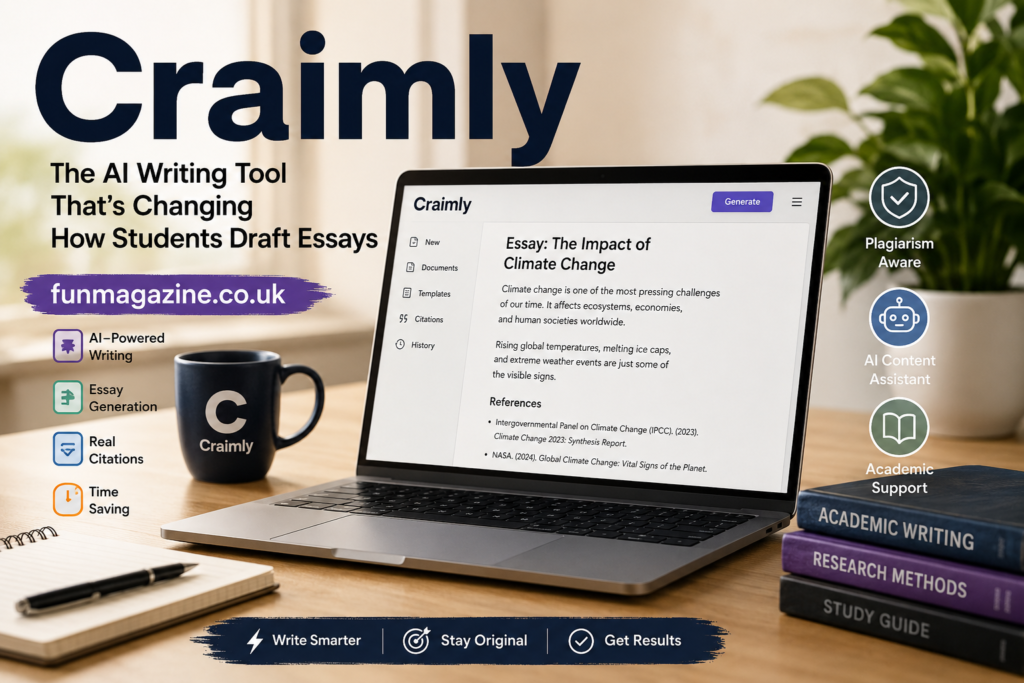

Craimly is commonly referred to as an AI-powered writing assistant. In simple terms, it’s a platform designed to help users generate written content quickly—especially essays, summaries, and academic-style text.
It works like most modern AI writing tools:
- You enter a topic or prompt
- The system generates structured content
- It often formats text into paragraphs, sections, and sometimes citations
The appeal is obvious. Instead of staring at a blank page, you get something that looks like a finished draft in minutes.
But “finished” doesn’t always mean “final.”
Why Craimly Became So Popular
There’s a reason tools like Craimly spread fast, especially among students.
1. Speed is everything
Writing a 10-page essay from scratch is exhausting. Craimly flips that timeline from hours into minutes.
2. It reduces mental pressure
Not everyone struggles with writing itself—many struggle with starting. Craimly gives people a starting point.
3. It feels like a shortcut to structure
Instead of worrying about introductions, arguments, and conclusions, users get a ready-made framework.
4. The “citation” promise
One of the biggest selling points is the idea that it can generate essays with references. That immediately makes it feel more “academic.”
But this is also where confusion starts.
How Craimly Actually Works (Behind the Scenes)
Let’s break it down simply.
Craimly-like tools are trained on large datasets of text. That means they don’t “know” facts the way a human researcher does. Instead, they predict what words and structures are most likely to come next based on patterns they’ve seen.
So when you type a prompt like:
“Write an essay on climate change causes”
The system doesn’t search a verified academic database. Instead, it:
- Builds sentences based on learned patterns
- Organizes them into essay structure
- May insert general-sounding citations based on common formats
That’s why outputs often look convincing—but still need human review.
The Truth About “Real Citations”
This is where things get interesting.
Craimly is often associated with claims like “real citations included.” But in practice, citation quality can vary.
What usually happens
- Some citations are formatted like academic sources
- Some may be generic or partially fabricated
- Some may not directly match the content in the essay
What that means for users
If you’re using Craimly for school or research:
You still need to verify every source manually.
Think of it like this:
The tool gives you a draft research paper, not a verified research paper.
Is Craimly Free from Plagiarism?
This claim needs careful handling.
AI-generated text is typically original in structure, but it is built from patterns learned from existing writing. That creates a few realities:
- It may unintentionally resemble existing phrasing
- It may repeat common academic explanations
- It may produce generic content that lacks originality depth
So while it’s often “plagiarism-free” in a technical sense, it’s not something you should blindly trust in academic or professional environments.
A smarter way to think about it:
Craimly helps you write faster, but it doesn’t replace responsibility for originality.
Can Craimly Be Detected by AI Checkers?
This is one of the most misunderstood topics.
No tool can guarantee invisibility from AI detectors.
Here’s why:
- AI detectors are inconsistent
- They rely on probability, not certainty
- Human writing sometimes gets flagged too
So when platforms say “undetectable AI writing,” that’s more marketing language than a technical guarantee.
If you’re using Craimly for academic work, the safest approach is always:
- Rewrite key sections in your own voice
- Add personal analysis
- Adjust tone and structure
That’s what actually makes writing feel human—not tricks or tools.
Where Craimly Actually Helps (Real Use Cases)
Let’s be fair here. Craimly isn’t just hype—it does have practical uses.
1. First drafts
Instead of starting from zero, you get a structured draft you can refine.
2. Essay outlines
It can quickly organize ideas into sections like introduction, body, and conclusion.
3. Study support
It’s useful for summarizing topics in simple language.
4. Brainstorming ideas
When you’re stuck, it gives you direction.
5. Language learning practice
Some users use it to see how ideas are structured in English.
Where Craimly Falls Short
Now for the part most people ignore.
1. Weak fact accuracy
It can generate confident-sounding but incorrect information.
2. Shallow reasoning
Long essays sometimes lack depth or critical thinking.
3. Citation uncertainty
Sources may not always be reliable or traceable.
4. Over-reliance risk
If used too heavily, it can reduce writing skill development.
Craimly vs Traditional Writing
Here’s a simple comparison:
| Feature | Craimly | Human Writing |
|---|---|---|
| Speed | Very fast | Slower |
| Accuracy | Needs checking | Usually higher |
| Creativity | Moderate | High |
| Effort | Low | High |
| Reliability | Mixed | Strong |
The takeaway is simple: Craimly is a support tool, not a replacement.
Who Should Use Craimly?
Craimly works best for:
- Students drafting essays
- Bloggers creating outlines
- Freelancers speeding up content creation
- Non-native English writers needing structure help
It’s not ideal for:
- Final academic submissions without editing
- Research-heavy papers requiring verified sources
- Legal, medical, or technical writing
The Smart Way to Use Craimly
Here’s where most people get it wrong—they either trust it too much or dismiss it completely.
The smarter approach is somewhere in the middle.
Step 1: Generate a draft
Use Craimly to build structure and ideas.
Step 2: Verify facts
Check every claim that matters.
Step 3: Rewrite in your voice
This is where the real quality comes in.
Step 4: Add insight
Bring in your own thinking, examples, or arguments.
That combination is what makes AI-assisted writing actually strong.
The Bigger Picture – Why Tools Like Craimly Matter
Craimly isn’t just about essays. It represents a bigger shift in how writing works.
We’re moving into a world where:
- Ideas matter more than formatting
- Editing matters more than first drafts
- Human judgment matters more than raw generation
The tools are getting better at writing—but humans still control meaning, accuracy, and trust.
That’s the real divide.
Conclusion
Craimly sits in that interesting middle space between convenience and caution.
It’s useful, fast, and sometimes impressive. But it’s not a magic solution for academic work or serious research. The output always needs a human layer—fact-checking, rewriting, and critical thinking.
If you treat it like a writing assistant instead of an authority, it becomes valuable. If you treat it like a replacement, it becomes risky.
That difference is everything.
FAQs About Craimly
1. What is Craimly used for?
It’s mainly used to generate essays, summaries, and structured written content using AI.
2. Is Craimly free to use?
Some versions may offer free features, but full functionality is often behind paid plans.
3. Does Craimly write plagiarism-free content?
It generates original text patterns, but users should still verify originality before submission.
4. Can Craimly be detected as AI writing?
There is no tool that guarantees undetectable AI content. Detection results vary.
5. Are Craimly citations reliable?
Not always. Citations should be manually checked for accuracy and legitimacy.
Read also: What is Tee Grizzley Net Worth? and How He Built It