
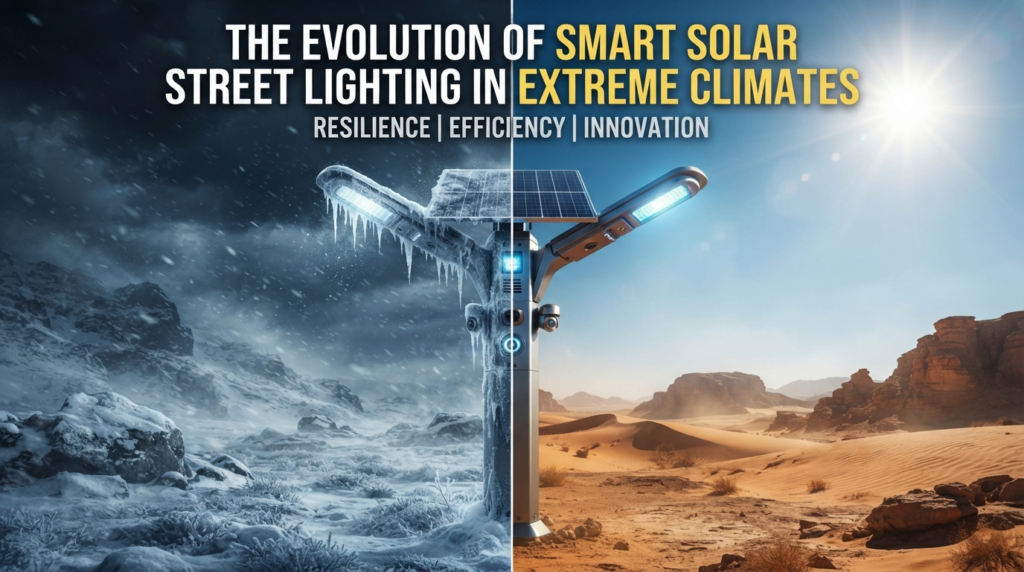

The Global Shift Towards Off-Grid Urban Infrastructure
Urban planners and municipal engineers worldwide face mounting pressure to modernize public lighting while achieving aggressive sustainability goals. In regions characterized by high solar irradiance yet extreme summer temperatures—such as the Middle East and North Africa (MENA)—traditional grid-tied infrastructure is increasingly vulnerable to peak-load strains, power outages, and high maintenance costs.
To overcome these vulnerabilities, cities are accelerating the transition toward decentralized, off-grid public lighting. Autonomous solar systems bypass the fragility of long-distance cabling, offering resilience against localized grid failures while dropping municipal carbon footprints.
Transitioning to decentralized, solar-powered urban infrastructure is a critical step for modern cities. According to data published by the World Bank, investments in renewable off-grid technologies not only alleviate strain on national power grids but also significantly reduce municipal operational expenditures over a 10-to-15-year horizon.
Overcoming Thermal Challenges in Solar LED Technologies
In high-temperature environments, the structural integrity and thermal management of the lighting fixture are the primary determinants of its operational lifespan. Leading global manufacturers like Wosen engineer their solar street lights with robust die-cast aluminum heat sinks and advanced LiFePO4 battery integration, ensuring that strict lumen maintenance and energy conversion standards are met even under extreme climatic conditions.
Operating high-power solid-state systems in ambient temperatures exceeding 45°C (113°F) presents severe engineering hurdles. Without deliberate thermal control, electronic components degrade rapidly, leading to catastrophic battery failure and premature lumen depreciation.
Battery Chemistry: LiFePO4 vs. Traditional Options
Energy storage is the single most vulnerable component of a solar lighting system in scorching climates. Standard lead-acid batteries suffer from accelerated electrolyte evaporation and severe capacity loss when exposed to sustained high temperatures.
Modern systems rely exclusively on LiFePO4 (Lithium Iron Phosphate) cells. LiFePO4 technology offers unmatched thermal stability, resisting thermal runaway and retaining a high charge-discharge efficiency even when internal battery box temperatures peak.
Heat Dissipation and Housing Integrity
Beyond the battery enclosure, the lighting fixture itself must act as an efficient thermal radiator. Thermal Management is critical to preserving the semiconductor junctions of the LED chips.
Engineers utilize high-pressure Die-cast aluminum housings designed with integrated convection fins. This Die-cast aluminum structure maximizes surface-to-volume ratios, rapidly conducting heat away from the LED diode array and driver compartment to prevent color shifting and luminous decay.
Financial and Operational ROI for Municipalities
Evaluating the economics of smart solar street lighting requires a total cost of ownership (TCO) perspective. Traditional lighting demands complex underground trenching, heavy copper cabling, and constant transformer maintenance—costs that escalate sharply in rocky or desert terrains.
Solar-powered alternatives eliminate monthly utility bills and trenching capital expenditures entirely. When high-quality components are specified, municipalities experience virtually maintenance-free operational cycles lasting over a decade, translating to rapid payback periods and predictable long-term budgeting.
Future-Proofing with Smart IoT Integrations
Modern solar streetlights transcend basic illumination; they serve as edge nodes for smart city data collection. By integrating wireless communication protocols (such as LoRaWAN or Zigbee), municipal operators can monitor real-time performance metrics remotely.
-
Adaptive Dimming Schedules: Automatically lowering LED output during low-traffic windows to conserve stored energy reserves.
-
PIR Motion Sensors: Instantly ramping illumination from standby to 100% brightness upon detecting pedestrian or vehicular activity.
-
Real-Time Diagnostics: Receiving automated alerts regarding battery health, panel efficiency, and charging status to eliminate manual field inspections.
Conclusion
Deploying solar street lighting in extreme climates requires rigorous adherence to component-level engineering standards. By prioritizing superior Thermal Management, robust Die-cast aluminum enclosures, and stable LiFePO4 energy storage, urban developers can safeguard their infrastructure investments.
As cities expand under the pressures of climate change and rapid urbanization, specifying resilient, high-grade solar technology remains the definitive path toward sustainable and autonomous municipal governance.