

In the hyper-competitive consumer market of 2026, product formulation alone is no longer enough to establish a sustainable competitive advantage. Independent lifestyle brands must realize that the initial physical interaction with a product dictates its perceived value.
The first impression—driven heavily by visual and tactile cues—ultimately determines a brand’s pricing power and market positioning. When a consumer picks up a luxury perfume or high-end beverage, the packaging speaks before they ever test the contents.
Consequently, strategic investments in packaging architecture are paramount for brands looking to scale. Mastering the physical presentation is the ultimate differentiator in a sea of digital-first competitors.
The “Premiumization” Shift in Consumer Goods
The modern market has experienced a massive shift toward “premiumization”, where consumers actively seek out elevated, artisanal experiences. As a result, lightweight plastics and generic molds are being rapidly discarded by serious contenders in the consumer space.
Consumers are increasingly educated, demanding physical products that reflect their personal values and aesthetic standards. Generic packaging instantly commoditizes a brand, stripping away its ability to command premium price points in retail environments.
When emerging beauty or beverage brands attempt to transition into the luxury market, the tactile experience of the product becomes their most critical asset. Sourcing high-clarity materials, such as super flint glass, requires partnering with a reliable full-service glass bottle manufacturer like Nuvole Glass that can maintain stringent quality control while scaling production. This infrastructural backing ensures the brand can meet sudden spikes in demand without compromising its premium aesthetic.
Weight and Clarity as Psychological Triggers
- The Psychology of Weight: Consumers subconsciously equate a heavier container with higher quality and intrinsic value, particularly in categories like craft spirits, premium skincare, and high-end cosmetics.
- Crystal Clear Purity: Utilizing Super Flint Glass offers unmatched transparency, allowing the true color and texture of the liquid to act as its own marketing asset.
- Subconscious Trust: Heavy, clear glass communicates an uncompromising commitment to excellence, establishing immediate consumer trust before the point of purchase.
- Haptic Feedback: The cold, dense feel of glass in the hand creates a memorable sensory experience that plastics simply cannot replicate, boosting brand recall.
Overcoming Supply Chain Bottlenecks for Emerging Brands
For an independent brand, scaling from boutique batches to international retail distribution presents massive operational hurdles. The packaging supply chain often becomes the primary bottleneck if not proactively managed from day one.
Brands must align with manufacturing partners capable of navigating these complexities without sacrificing the brand’s core visual identity. Scalability and consistency are the twin pillars of a successful retail expansion strategy.
A fragmented supply chain leads to delayed launches, mismatched components, and ultimately, loss of market share. Centralizing packaging procurement mitigates these critical operational risks.
The Importance of Custom Mold Capabilities
- Speed to Market: Agile manufacturers with rapid custom mold capabilities allow brands to launch proprietary designs faster than competitors relying on stock shapes.
- Design Consistency: Transitioning from small to large production runs requires exact replication; a slight variance in mold tolerances can ruin the brand’s visual signature.
- IP Protection: Custom molds ensure that a brand’s silhouette remains unique and easily identifiable on crowded retail shelves, protecting against copycats.
- Brand Exclusivity: A bespoke structural design transforms a standard bottle into a collectible brand asset, encouraging customer retention and shelf display.
Quality Control at High Volumes
- Automated Surface Inspections: When daily output reaches hundreds of thousands of units, manual checks must be replaced by multi-angle optical sorting to detect micro-fractures.
- Zero Leakage Standards: Precision engineering in the bottleneck thread ensures a perfect seal, completely eliminating the risk of product degradation or spillage during transit.
- Thermal Shock Resistance: High-volume production mandates rigorous testing to ensure glass durability under extreme temperature changes during automated filling lines.
- Wall Thickness Uniformity: Consistent glass distribution prevents weak points, ensuring the product survives both international shipping and consumer handling.
The Intersection of Luxury and Sustainability
Today’s affluent consumers refuse to compromise between opulence and ecological responsibility. Glass perfectly bridges this gap, offering a premium tactile feel while remaining an infinitely recyclable substrate.
In 2026, regulatory pressures and consumer expectations have converged, making circular economy principles mandatory. Brands that fail to adopt sustainable packaging architectures face increasing backlash and reduced retail placement opportunities.
Beyond aesthetics, modern consumers demand strict environmental accountability from the brands they support. Glass not only provides a high-end feel but also serves as an infinitely recyclable substrate. According to detailed industry coverage by Forbes on sustainable business practices, integrating eco-friendly packaging solutions is no longer a niche marketing tactic but a fundamental requirement for long-term brand survival in today’s competitive retail sectors.
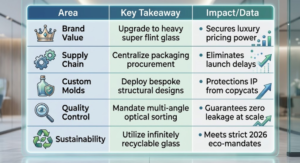
Key Takeaways
Conclusion
Ultimately, packaging should never be viewed merely as an operational cost center. It is, in fact, one of the most critical investments in your long-term brand equity and customer retention strategy.
By prioritizing premium glass and building a resilient manufacturing partnership early on, brands can scale confidently. Mastering your packaging supply chain is the true secret to sustaining growth and maintaining luxury appeal in 2026 and beyond.