
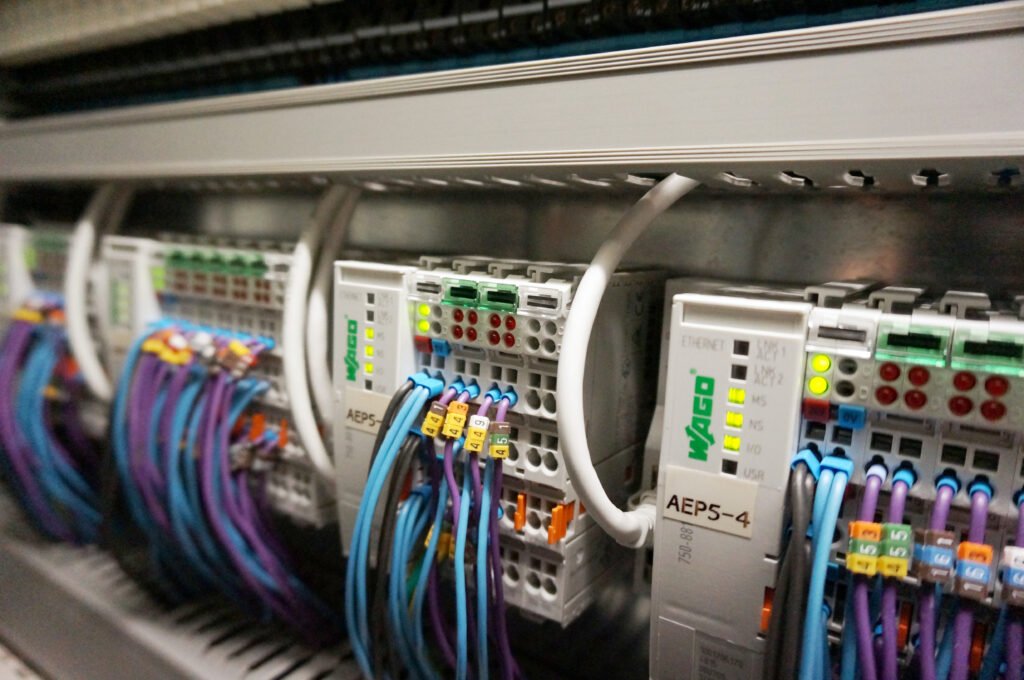

The Invisible Threat to Modern Microprocessors
Modern industrial manufacturing relies on real-time deterministic computing to synchronize high-speed operations. Automated facilities deploy dense networks of Programmable Logic Controllers (PLCs), multi-axis robotic arms, servo drives, and Variable Frequency Drives (VFDs) to maximize production throughput.
To achieve higher processing efficiency, modern industrial microprocessors utilize silicon lithography nodes below 10 nanometers. These advanced chips operate on internal logic thresholds between 1.2V and 3.3V DC.
While these sub-micron architectures deliver exceptional computational performance, they exhibit minimal dielectric breakdown tolerance. A transient overvoltage lasting less than 3 microseconds can deliver thousands of volts into a sensitive semiconductor junction.
For high-output facilities, the financial fallout of unmitigated electrical noise extends far beyond hardware replacement. Unplanned downtime costs across automated automotive, pharmaceutical, and semiconductor plants frequently exceed $250,000 per hour in lost production capacity, corrupted batches, and labor overhead.
Engineering a Cascaded Electrical Defense Architecture
When multinational corporations design electrical safety protocols for their global facilities—particularly across Europe and Latin American markets—procurement engineers must align technical specifications across different languages and regional standards. In these engineering frameworks, heavy-duty industrial surge protector manufacturers like LSP are mandated at both the grid-entry point and within individual control cabinets. These components utilize advanced Metal Oxide Varistors (MOVs) to instantly clamp voltage spikes before they can reach sensitive logic boards.
Relying on an isolated suppression device at the main service disconnect leaves downstream control circuits fully exposed to localized inductive spikes.
Layering Primary and Secondary Defenses
A resilient facility architecture implements a multi-tiered, coordinated suppression strategy. This cascaded topology absorbs energy sequentially across facility power distribution boundaries:
- Type 1 / Class I (Service Entrance Defense): Positioned immediately adjacent to the main facility transformer or medium-to-low voltage switchgear. These heavy-duty arresters dissipate lightning impulse currents characterized by the high-energy 10/350 µs waveform.
- Type 2 / Class II (Branch & Sub-Panel Suppression): Integrated directly into Motor Control Centers (MCCs) and distribution panelboards. They attenuate residual energy and internal switching spikes using the 8/20 µs impulse waveform.
- Type 3 / Class III (Point-of-Use Control Protection): Mounted onto 35mm DIN rails immediately upstream of 24V DC switch-mode power supplies (SMPS), fieldbus gateways, and analog signal conditioners.
- Coordinated Energy Dissipation: Maintaining engineered cable run lengths or decoupling chokes between Type 1 and Type 2 stages ensures that upstream devices conduct primary surge current before downstream units experience thermal overload.
Global Procurement and Terminology
Designing power quality specifications for cross-border operations requires navigating diverse regulatory nomenclature without compromising mechanical or electrical performance.
Global procurement teams must bridge discrepancies between regional engineering terminologies:
- Harmonized Standards Mapping: Devices cataloged as industrial surge arresters, transient voltage surge suppressors (TVSS), or overvoltage limiters must align with both IEC 61643-11 and UL 1449 5th Edition criteria.
- Maximum Continuous Operating Voltage ( MCOV): Engineers must verify that nominal continuous voltage limits accommodate local grid fluctuations, ensuring at least 20% headroom above nominal utility voltage.
- Voltage Protection Level ( Specifiers must cross-examine the device’s peak clamping voltage against the equipment’s impulse withstand rating, keeping let-through peaks well below the 1.5 kV damage threshold of standard PLC power rails.
- Response Velocity: Specifying high-speed Metal Oxide Varistor (MOV) arrays paired with Gas Discharge Tubes (GDTs) guarantees sub-25-nanosecond response times, stopping voltage rise rates before gate oxide puncture occurs.
Internal vs. External Electrical Anomalies
Plant personnel frequently associate surge hazards exclusively with severe external atmospheric phenomena. However, long-term power quality monitoring reveals that approximately 80% of transient overvoltages originate inside the industrial facility.
Internal electrical transients recur thousands of times each operational shift, slowly eroding semiconductor junctions through cumulative dielectric stress:
- Inductive Load Disconnection: Opening contactors on heavy three-phase induction motors, industrial chillers, and hydraulic pump stations creates substantial inductive kickback, projecting spikes exceeding 3,000V onto common buses.
- Variable Frequency Drive Harmonics: High-frequency pulse-width modulation (PWM) inverters utilizing fast-switching IGBT stages introduce high-frequency voltage reflections along long motor cables, back-feeding destructive noise into control cabinets.
- Capacitive Power Factor Correction: The routine automatic switching of power factor capacitor banks generates high-energy oscillatory transients that bypass standard step-down transformers.
- External Grid Instability: External threats—including utility transmission switching, automatic re-closer operations, and indirect lightning electromagnetic pulses (LEMP)—deliver massive, low-frequency current surges into the facility grounding grid.
- Latent Semiconductor Degradation: Repetitive micro-spikes degrade internal bypass diodes and capacitor filter banks, manifesting as intermittent network dropouts, processor lockups, and unexplainable data packet corruption.
Adhering to Global Uptime and Safety Standards
Facility managers cannot rely on guesswork when protecting multi-million-dollar infrastructure. The integration of transient voltage suppression must comply with rigorous international standards, such as the IEC 61643 series. This is especially critical when the facility relies heavily on automated assembly lines driven by a programmable logic controller (PLC). Because PLCs operate on extremely low voltage logic, even a minor electrical anomaly that breaches the panel can corrupt the memory, halt production sequences, and require complete system recalibration.
Standardized electrical design protects capital equipment, guarantees electrical safety, and satisfies industrial underwriting mandates:
- IEC 61643-11 & 61643-21: Defines precise laboratory testing regimens, short-circuit current ratings, and thermal disconnection parameters for low-voltage power networks and high-speed data loops.
- NFPA 79 (Electrical Standard for Industrial Machinery): Strictly mandates dedicated surge protection for industrial automation systems containing safety-related logic circuits to prevent hazardous control system lockouts.
- UL 1449 Short-Circuit Current Rating (SCCR): Verifies that the internal safety disconnection mechanism safely isolates a failed varistor without rupturing the enclosure or creating an electrical arc-flash incident.
- Thermal Runaway Mitigation: Certified industrial surge devices incorporate internal mechanical thermal disconnectors and front-panel optical diagnostic windows, supplemented by dry alarm contacts for direct PLC status monitoring.
Conclusion: Making Power Quality a Priority
In modern automated production, clean electrical power is a fundamental operational baseline. The capital cost of implementing high-grade, cascaded surge protection represents a microscopic fraction of overall facility investment.
Conversely, failing to mitigate transient overvoltages exposes automated lines to catastrophic component failure, corrupted industrial fieldbus protocols, and devastating downtime costs.
Facility managers, industrial electrical engineers, and corporate infrastructure executives must treat transient suppression as an active engineering discipline. By auditing facility power architectures, enforcing cascaded protection, and adhering to strict international engineering standards, automated plants can safeguard their computing hardware and maintain continuous operational uptime.